How well do LLMs understand Nigeria?
Open scores for how well LLMs perform in different downstream tasks in Hausa, Igbo, Yoruba, and Pidgin. i
Overall
iBreakdown
· click a column to sortiCompare models
Two models side by side on the same Nigerian-language test questions.
Benchmark results
iBy task
0–100 · higher is betteriEvery language, with statistics
Score difference on the same questions (first model minus second). Bold = statistically clear (paired bootstrap, 95%).
English vs Nigerian languages
Ring = English score, dot = Nigerian average. A shorter line means a smaller language gap.
Nigerian Datasets
Datasets for building and testing AI in Hausa, Igbo, Yoruba, Nigerian Pidgin and other Nigerian languages, from sentiment and news to speech, translation, reading comprehension, maths and safety. Browse them all, or switch to the select few our leaderboard scores models on.
Our leaderboard tests models on a select few of these datasets, marked On leaderboard.
All datasets
iEvery model on the leaderboard is scored on these datasets, with the same questions and prompts.
How it's used: example questions and model answers
Models
Published AI models for Nigerian languages, from chat models and translators to speech recognition and text-to-speech, and the ones our leaderboard has tested.
New: speech-to-text API. Transcribe Hausa, Igbo, Yoruba and Nigerian-accented English with the NCAIR models, OpenAI-compatible and free to use. Get an API key →
We test a select few of these models on our benchmarks, marked On leaderboard.
All models
iThese models have been run on every benchmark.
Try speech recognition
Hear how the NCAIR speech models transcribe Hausa, Igbo, Yoruba and Nigerian-accented English. Play a sample, upload a short clip or record yourself. Want it in your app? Get a free API key →
Asks your model each question with a short answer limit and temperature 0, then scores it exactly as on the leaderboard. Takes a few minutes; you can stop at any time.
Products
We turn research for Nigerian languages into tools people can use.
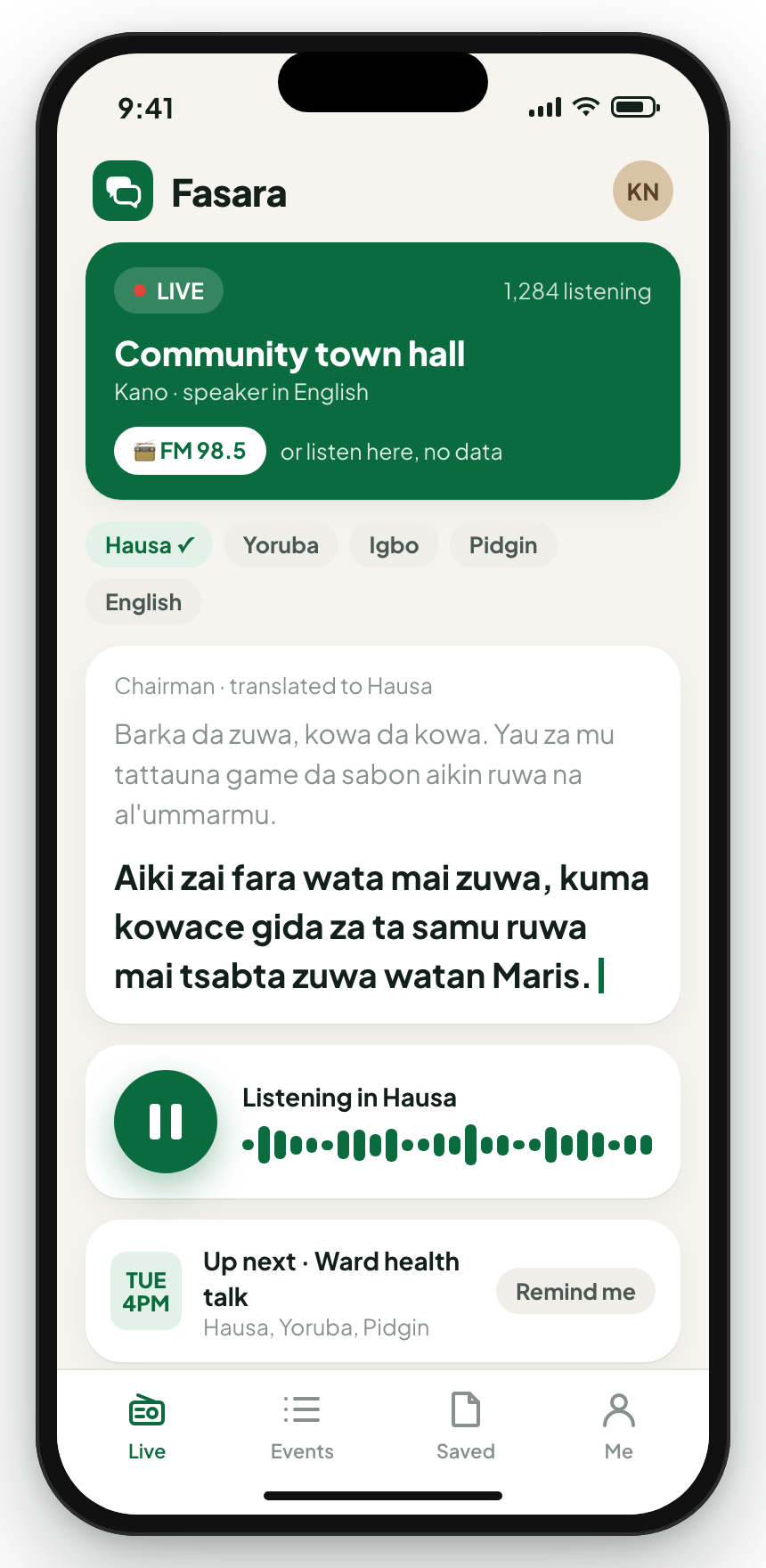
Fasara
Every word, in your language.
Live interpretation for meetings, lectures, events and services, between English and Hausa, Yoruba, Igbo and Pidgin. Listen on FM radio or your phone, with no data needed.
fasara.naijallm.com ↗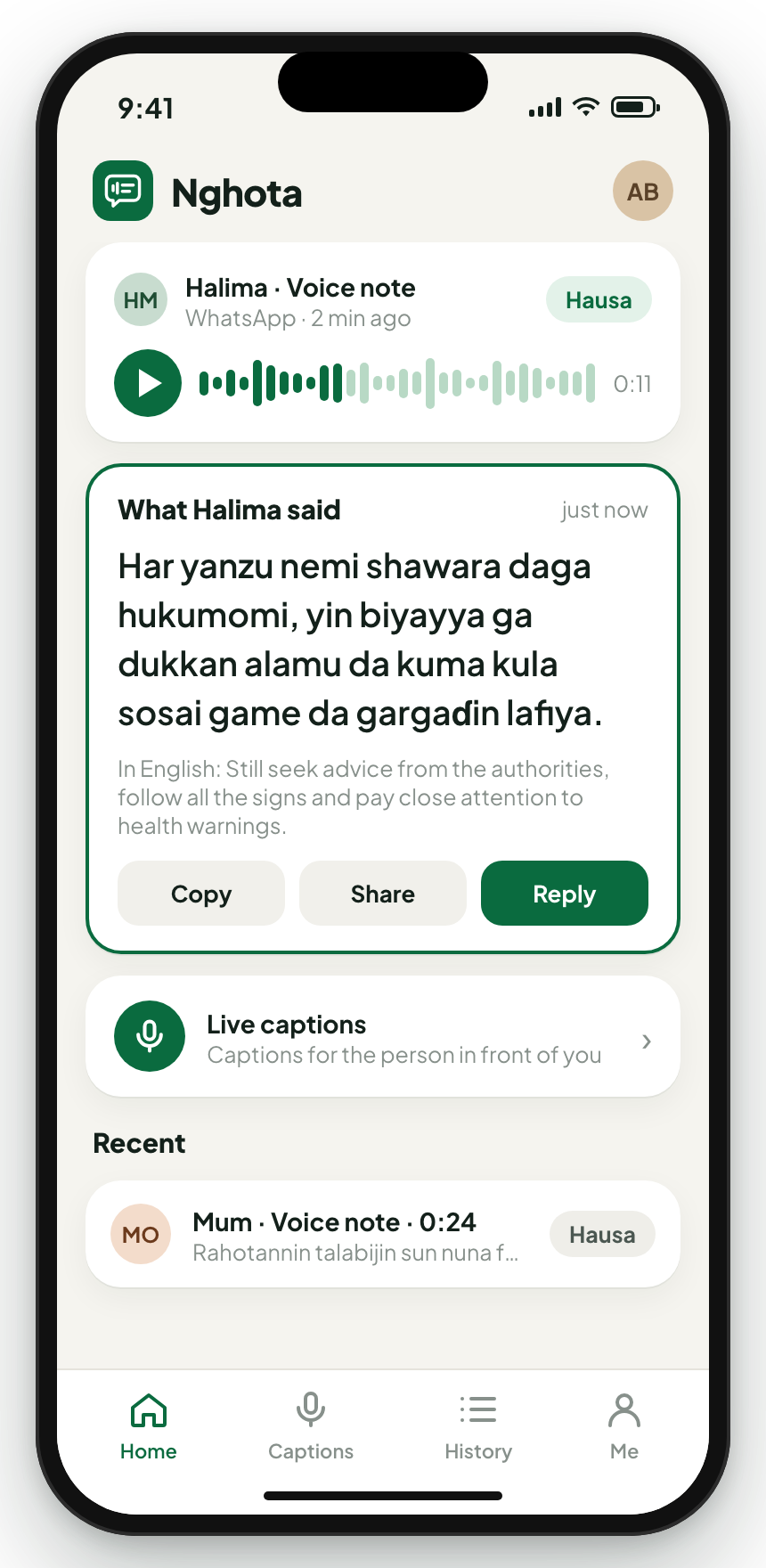
Nghota
See what is said.
Turns any audio into text (voice notes, recordings, videos, calls and conversations) in Hausa, Yoruba, Igbo, Pidgin and English, built first for deaf and hard-of-hearing people.
nghota.naijallm.com ↗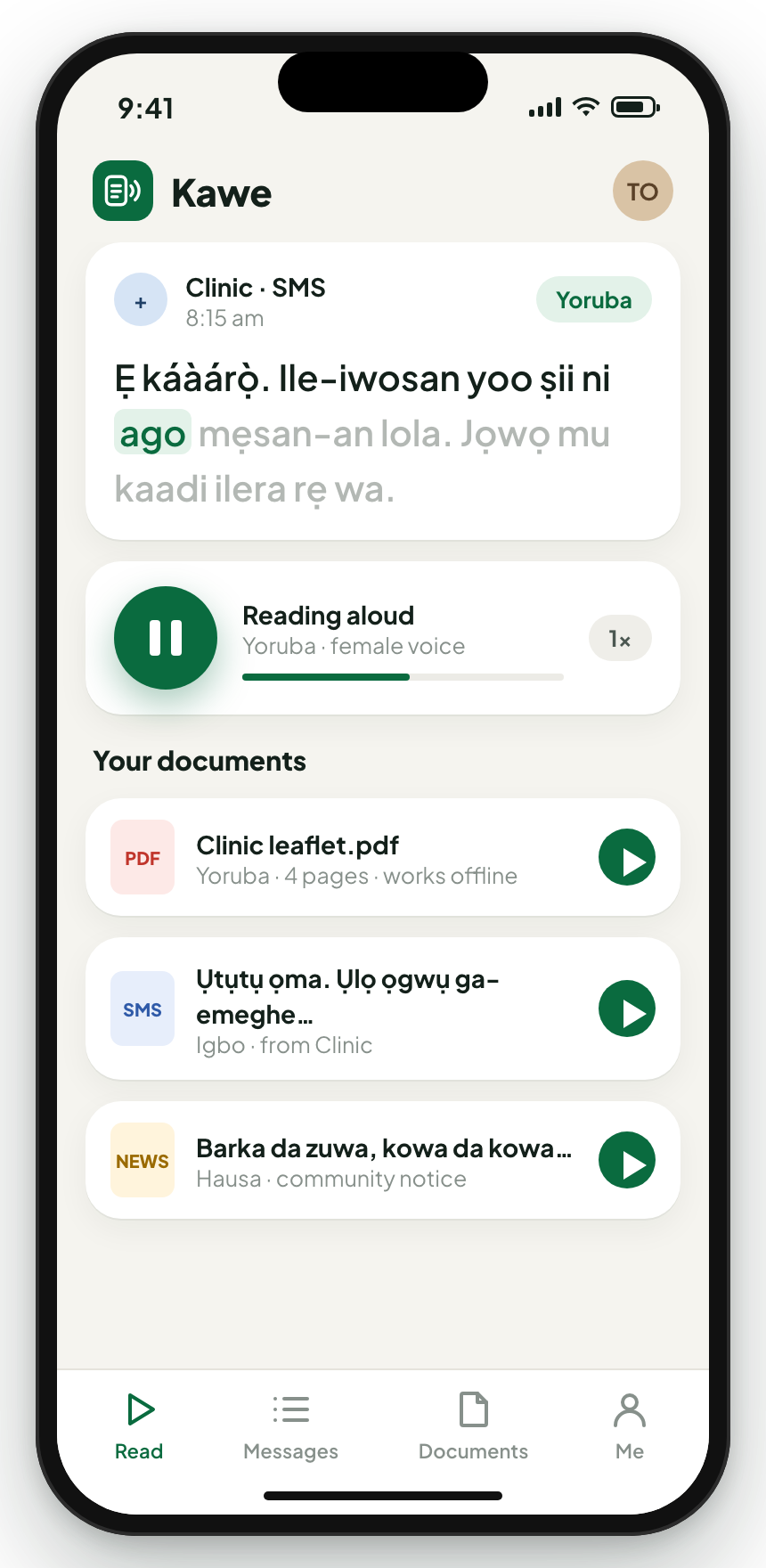
Kawe
Your phone, reading to you.
A read-aloud voice for Hausa, Yoruba, Igbo and Pidgin: hear messages and apps, or upload documents written in Nigerian languages, even offline.
kawe.naijallm.com ↗For developers
Build your own: free speech-to-text for Hausa, Igbo, Yoruba and Nigerian English. Get an API key at asr.naijallm.com ↗
About
What this leaderboard is, how it is scored, and what to keep in mind.
What is this?
A repeatable benchmark of language models on Nigerian languages. N-ATLAS, Nigeria's open LLM, is the current spotlight.
How are scores calculated?
- Full test sets, limited to Hausa, Igbo, Yoruba, Pidgin and English, except the samples noted below. Same prompts for every model.
- Each benchmark keeps its original metric: weighted F1 (NaijaSenti, MasakhaNEWS), accuracy (AfriXNLI, AfriMMLU, MMLU-Pro), exact match (AfriMGSM), chrF++ (FLORES+ v4.7), strict accuracy (IFEval), refusal rate (LSR).
- Task scores on the leaderboard are the plain average of their benchmarks. Overall averages the task categories built on Nigerian and African-language benchmarks; English-only benchmarks (IFEval, MMLU-Pro) are not counted in it. "Nigerian" means the average of Hausa, Igbo and Yoruba.
- Every score has a 95% bootstrap confidence interval; comparisons are paired on the same questions.
How were the models run?
- Open models: locally with MLX at 8-bit precision, greedy decoding, no thinking mode.
- Gemini 3.1 Pro: batch API, provider-default sampling, thinking LOW (it cannot be turned off).
- DeepSeek V4-Pro: DeepSeek API, provider-default settings.
- Answers are parsed by rule. LSR safety answers are graded by GPT (gpt-6-astra), a provider none of the graded models come from.
What should I keep in mind?
- Gemini and DeepSeek V4-Pro use a fixed 1,000-tweet NaijaSenti sample per language, and DeepSeek's FLORES uses 200 sentences per direction (cost). Gemini's MMLU-Pro is the published Vals AI figure (shown in italics, not ranked).
- Requests that failed at the API are excluded rather than scored wrong (0.7% of Gemini requests).
- LSR has 14 prompts per language, so its intervals are wide. The score counts only clear refusals; answers that show the model did not understand the request (gibberish, wrong language) are counted separately, not as refusals.
- Pidgin and Igala are not in N-ATLAS's training data.
- Public benchmarks may appear in any model's training data.
How can I reproduce the results?
- Models: the exact checkpoints linked on the Models page (Hugging Face), or the provider API named there.
- Local runs: converted to MLX at 8-bit (group size 64) with mlx-lm; greedy decoding; each model's own chat template with thinking turned off (DeepSeek-R1-Distill: thinking on, up to 8,192 extra tokens); one user turn, no system prompt.
- Answer limits: 16 new tokens for label and letter answers, 256 for translations, 400 for IlùBench, 512 for maths and safety prompts, 1,024 for IFEval and MMLU-Pro.
- Data: each benchmark's public test split, limited to Hausa, Igbo, Yoruba, Nigerian Pidgin and English; FLORES+ at revision 4.7; samples as listed in How these scores are calculated.
- Scoring: answers parsed by fixed rules (first valid label or letter; last number for maths; official extraction for MMLU-Pro and IFEval); unreadable answers count as wrong; 95% intervals from 1,000 bootstrap resamples; safety answers graded by an OpenAI model into four outcomes.
- Results: every score is downloadable as CSV or JSON. The evaluation code is not public yet; for questions, email ayuba@naijallm.com.